 15 April 2026
The Complete Guide to Button Mushroom Farming in India: Setup Cost, Consultant Services, DPR, and Profitability Analysis
Introduction: Why Mushroom Farming Is India’s Fastest-Growing Agribusiness Opportunity in 2026
If you are searching for mushroom farming in India, button mushroom cultivation cost, mushroom consultant near me, mushroom plant setup, commercial mushroom farming business plan, mushroom unit DPR, mushroom training in Lucknow, mushroom farming subsidy, or how to start mushroom business in India, you have arrived at the most comprehensive resource available today.
Button mushroom farming has emerged as one of the most profitable and scalable agribusiness opportunities in India, particularly for progressive farmers, FPOs (Farmer Producer Organizations), entrepreneurs, and investors looking for high-value, controlled-environment agriculture. Unlike traditional crops that depend heavily on unpredictable weather and seasonal variations, mushroom cultivation offers a predictable, technology-driven production system with year-round income potential.
However, the ground reality is more nuanced than promotional claims suggest. This is not seasonal farming like wheat or vegetables. It is a controlled biological production system, where temperature, humidity, compost quality, spawn selection, and hygiene must be managed with scientific precision every single day.
Many investors, farmers, and agricultural entrepreneurs enter this sector with enthusiasm but without complete system understanding. They invest in infrastructure but neglect compost quality. They achieve good production in one cycle but fail to maintain consistency across seasons. They produce mushrooms but struggle to sell due to lack of cold chain infrastructure or proper market linkage.
The core truth is simple:
Mushroom farming is profitable only when all systems are perfectly aligned—compost quality + climate control + cold chain + market linkage + expert guidance.
If you treat it casually, it becomes a liability. If you treat it as a disciplined, scientifically managed agribusiness with the right consultant and training, it becomes a long-term income-generating asset.
Understanding Button Mushroom Farming as a Complete System, Not Just a Crop
Button mushroom cultivation is fundamentally different from traditional agriculture. It is a closed-loop production system where every stage directly affects the next. Unlike crops that depend on soil fertility and weather patterns, mushroom farming depends on controlled inputs, precise environmental conditions, and systematic process management.
The system has five interconnected pillars that must work in perfect coordination:
- Compost Preparation (Phase 1 bunker composting and Phase 2 tunnel pasteurization)
- Controlled Growing Rooms (insulated chambers with HVAC, humidity control, and CO₂ management)
- Casing and Crop Management (application of casing soil, spawn run monitoring, pin formation, and cropping cycle management)
- Harvesting and Cold Storage (pre-cooling, cold storage at 0-4°C, and temperature-controlled transportation)
- Market Linkage and Distribution (direct contracts with hotels, restaurants, supermarkets, food processing units, and export channels)
Each of these functions must operate smoothly and in perfect synchronization. For example, even if compost quality is perfect, a small temperature fluctuation of just 2-3°C during the cropping stage can reduce yield by 20-30%. Similarly, even if production is excellent, lack of proper cold storage and timely transportation can reduce market value by 40-50% within 24 hours.
Ground Reality Insight:
Mushroom farming is like running a small biological factory where precise process control replaces machinery. If one department fails or underperforms, the entire output quality and quantity are affected. This is why successful mushroom farms focus on process discipline, system integration, and continuous monitoring, not just production volume alone.
What Is the Actual Cost of Mushroom Farming in India? Complete Investment Breakdown
This is one of the most frequently searched and critically important questions for anyone planning to enter mushroom farming.
Investment Range for Different Scales
- Small-scale unit (5-10 ton compost capacity per cycle): ₹40 lakh to ₹80 lakh
- Medium-scale unit (15-30 ton compost capacity): ₹1 crore to ₹2.5 crore
- Large commercial unit (50+ ton capacity): ₹5 crore and above
Where Does the Investment Actually Go?
The cost is not just for civil construction or shed building. The investment is distributed across multiple critical components:
| Component | Estimated Cost Range |
| Insulated growing rooms (PUF panels, insulation) | ₹8-15 lakh per room |
| Compost bunker system (Phase 1) | ₹15-25 lakh |
| Compost tunnel (Phase 2 pasteurization) | ₹30-60 lakh |
| HVAC and climate control systems | ₹20-40 lakh |
| Boiler and steam generation system | ₹15-25 lakh |
| Cold storage and pre-cooling units | ₹25-50 lakh |
| Machinery, electrical, and automation | ₹10-20 lakh |
| Component | Estimated Cost Range |
| Insulated growing rooms (PUF panels, insulation) | ₹8-15 lakh per room |
| Compost bunker system (Phase 1) | ₹15-25 lakh |
Many beginners try to reduce project cost by eliminating or downgrading essential components like Phase 2 tunnels, cold storage, or proper insulation. While this may reduce the initial capital expenditure, it dramatically increases long-term operational losses due to:
- Inconsistent compost quality leading to yield fluctuations
- Poor climate control causing crop failures
- Product quality degradation without cold chain
- Higher rejection rates and lower market prices
Ground Reality:
In mushroom farming, saving money at the setup stage by cutting corners often results in 2-3 times higher operational losses and revenue reduction in subsequent years. Proper infrastructure is not an option—it is a necessity for consistent profitability.
Mushroom Plant Setup in India: Core Infrastructure Components Explained in Detail
Compost Bunker (Phase 1 Composting)
The composting process begins in specially designed bunkers. These are reinforced RCC structures designed to allow proper aeration, drainage, and moisture retention.
Raw materials including:
- Wheat straw or paddy straw
- Fresh chicken manure or poultry litter
- Gypsum (calcium sulfate)
- Urea (nitrogen supplement)
are mixed in specific proportions and allowed to decompose through controlled microbial activity. The internal temperature generated during this aerobic fermentation process can reach up to 65-75°C, which is essential for breaking down lignin and cellulose in raw materials into a biologically active substrate suitable for mushroom mycelium growth.
Field Insight:
Uniform moisture distribution (60-65%), proper turning schedule (every 3-4 days), and maintaining the right carbon-to-nitrogen ratio (30:1 to 33:1) are absolutely critical. Many farms fail at this first stage itself because compost preparation is uneven, leading to inconsistent spawn run and highly variable yields across different beds and batches.
Compost Tunnel (Phase 2 Pasteurization and Conditioning)
After Phase 1 composting (typically 18-22 days), the compost is transferred to enclosed pasteurization tunnels for Phase 2 processing.
This stage involves three critical sub-processes:
- Steam pasteurization at controlled temperature (58-62°C for 6-8 hours) to eliminate competitor organisms, pathogens, and pest eggs
- Ammonia removal through controlled fresh air introduction and extended conditioning (2-3 days)
- Biological stabilization to achieve optimal moisture, pH, and microbial balance
Ground Reality:
Improper tunnel operation is one of the most common technical failures in mushroom farming. High residual ammonia levels (above 5-10 ppm) directly inhibit mushroom mycelium growth, leading to poor spawn run, delayed pinning, and drastically reduced yields. Investing in a properly designed tunnel with accurate temperature and airflow control is non-negotiable for commercial success.
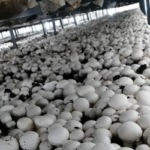
Mushroom Growing Chambers (Climate-Controlled Production Rooms)
These are specially designed, insulated rooms where the actual mushroom cultivation takes place after spawn inoculation.
Key infrastructure components include:
- PUF insulation panels (100-150mm thickness) for temperature stability
- Multi-tier steel racks (typically 5-6 tiers to maximize vertical space utilization)
- Air Handling Units (AHUs) with precise temperature and humidity control
- Humidification systems (ultrasonic or high-pressure misting)
- CO₂ monitoring and ventilation systems
- Automated or semi-automated climate controllers
Environmental conditions must be maintained with extreme precision:
- Spawn run stage: 22-25°C, 85-90% relative humidity, minimal fresh air
- Cropping stage: 14-18°C, 80-85% relative humidity, regular fresh air exchange for CO₂ management
Practical Insight:
Even a temperature variation of just 2°C during the cropping stage can impact mushroom quality, size uniformity, and overall yield by 15-25%. Uniform airflow distribution throughout the room is essential to ensure consistent crop development across all racks and tiers.
Casing material (a mixture of sterilized soil, peat moss, and lime) is applied on top of the fully colonized compost after spawn run completion. This layer plays a crucial triggering role in pin formation (the initiation of mushroom fruiting bodies).
The casing layer helps:
- Maintain surface moisture for uniform pin formation
- Provide a stable micro-environment with appropriate pH
- Support consistent mushroom growth and size distribution
Ground Reality:
Casing is not just a passive protective layer—it is a critical biological trigger. Poor quality casing soil, incorrect moisture content, or improper application results in delayed or uneven cropping, significantly affecting harvest cycles and overall profitability.
Spawn Quality (The Foundation of Yield Potential)
Spawn is the seed material containing mushroom mycelium grown on sterilized grain substrate (typically wheat or rye). It determines the genetic potential, disease resistance, and productivity of your entire crop.
Quality spawn must be:
- Fresh (ideally used within 15-20 days of production)
- Completely free from bacterial, fungal, or viral contamination
- Produced from genetically superior parent strains
- Suitable for your specific climatic and seasonal conditions
Practical Insight:
Using low-quality or contaminated spawn to save ₹5-10 per kg is one of the most expensive mistakes in mushroom farming. Poor spawn leads to slow colonization, competitor mold growth, crop failures, and massive financial losses that far exceed any initial savings.
Cold Storage and Cold Chain Infrastructure
Mushrooms are highly perishable with a shelf life of only 24-48 hours at ambient temperature. Post-harvest handling is as critical as cultivation itself.
Required cold chain infrastructure includes:
- Pre-cooling room (2-4°C) for rapid temperature reduction immediately after harvest
- Cold storage facility (0-2°C, 85-90% RH) for short-term storage
- Refrigerated transportation for supply to distant markets
- Proper packaging materials (breathable plastic trays, MAP packaging)
Ground Reality:
Without an efficient cold chain, mushroom shelf life reduces drastically within hours. This leads to rapid quality deterioration, price crashes due to distress selling, high rejection rates from buyers, and ultimately unsustainable business operations.
Mushroom Market Demand and Supply Dynamics in India (2026 Update)
The demand for mushrooms in India is steadily increasing due to multiple converging factors:
- Rising health awareness and preference for low-calorie, high-protein vegetarian foods
- Growing vegetarian and vegan population seeking plant-based protein alternatives
- Rapid expansion of organized retail chains, supermarkets, and online grocery platforms
- Increasing consumption in hotels, restaurants, catering services (HoReCa sector)
- Export opportunities to Middle East, Europe, and Southeast Asian markets
However, the supply side remains fragmented, unorganized, and concentrated in specific regions, creating significant opportunities for well-managed commercial units.
- Mushroom prices fluctuate seasonally (₹80-250 per kg depending on season and location)
- Supply chains are poorly organized with multiple intermediaries
- Quality consistency and grading standards are major industry-wide issues
- Cold chain infrastructure is inadequate in most regions
Farmers and entrepreneurs who can provide consistent quality, proper grading, hygienic packaging, and reliable supply discipline can build strong market positioning, premium pricing power, and long-term buyer relationships with hotels, supermarkets, food processors, and export houses.
Best States and Regions for Mushroom Farming in India
Highly Suitable States (Natural Climate Advantage)
- Punjab – Established mushroom ecosystem, skilled labor, good market access
- Haryana – Proximity to Delhi-NCR markets, favorable climate during season
- Himachal Pradesh – Ideal natural temperature, government support schemes
- Uttarakhand – Cool climate, growing local and export demand
Emerging and High-Potential Regions
- Maharashtra – Large urban markets (Mumbai, Pune), growing demand
- Gujarat – Strong entrepreneurial culture, access to processing units
- Uttar Pradesh (Lucknow, Noida, Meerut) – Large population, increasing awareness
- Bihar – Recently emerged as top producer with government subsidy schemes
- Karnataka (Bangalore region) – High consumption, tech-driven farming interest
- Tamil Nadu – Expanding retail and HoReCa sectors
Practical Site Selection Insight
Location should be strategically chosen based on:
- Proximity to target markets (reducing logistics cost and time)
- Reliable electricity supply (critical for climate control and cold storage)
- Availability of skilled or trainable labor
- Access to quality raw materials (straw, manure, spawn suppliers)
- Water quality and availability
Not just on land cost or personal convenience. A poorly located farm will struggle regardless of infrastructure quality.
Step-by-Step Approach to Start Mushroom Farming Business in India
- Decide scale carefully – Avoid units that are too small (unviable) or too large (unmanageable for first-time entrepreneurs)
- Conduct detailed market feasibility study – Identify buyers, understand pricing, analyze competition
- Prepare comprehensive Detailed Project Report (DPR) with realistic financial projections
- Design infrastructure scientifically with expert mushroom consultant guidance
- Arrange financing through bank loans, NABARD schemes, state horticulture subsidies
- Build and train a dedicated technical team (production manager, compost expert, marketing personnel)
- Start with trial production cycles to stabilize processes before scaling up
- Focus on system stabilization over 6-12 months before expecting consistent profitability
Ground Reality:
The first year of mushroom farming is primarily for learning, process refinement, and system stabilization, not for maximum profit extraction. Entrepreneurs who rush into full-scale production without adequate preparation and learning face the highest failure rates.
Common Mistakes in Mushroom Farming That Lead to Gradual Losses
- Weak compost preparation due to improper raw material selection, moisture imbalance, or inadequate Phase 2 processing
- Ignoring precise temperature and humidity control requirements
- Poor quality spawn selection to save costs
- Lack of adequate cold storage and cold chain infrastructure
- No clear market planning or buyer contracts before production begins
- Treating mushroom farming as passive income requiring minimal daily attention
- Underestimating working capital requirements for continuous operations
- Inadequate technical training of staff and management
These mistakes typically do not cause immediate catastrophic failure. Instead, they lead to gradual erosion of profitability through inconsistent yields, quality issues, market rejections, and inability to command premium prices—ultimately making the business financially unviable over 2-3 years.
Why Expert Mushroom Consultant Services Are Critical for Success
Given the technical complexity and precision requirements of commercial mushroom farming, engaging an experienced mushroom cultivation consultant is not optional—it is essential for long-term viability.
What a Professional Mushroom Consultant Provides
- Comprehensive feasibility analysis and DPR preparation tailored to your location, scale, and market
- Scientific plant design and layout optimization for operational efficiency
- Vendor evaluation and equipment procurement guidance
- Compost formulation and quality control protocols
- Staff training and skill development programs
- Troubleshooting services for yield issues, contamination problems, climate control failures
- Market linkage support and buyer introductions
- Ongoing technical support during critical production phases
J.K. Singh – India’s Leading Mushroom Expert and Consultant
J.K. Singh, founder director of Krishigence Pvt. Ltd. (www.mushroomguru.in), is recognized as one of India’s most experienced and accomplished mushroom technology experts with unmatched credentials:
- 49+ years of hands-on experience in mushroom science, cultivation, and agribusiness
- Established more than 20 commercial mushroom units across multiple states in India
- Contributed to over 150 agribusiness projects including food parks, mega food parks, cold chain systems, and processing units
- Trained thousands of farmers and entrepreneurs through workshops, field demonstrations, and consultancy projects
- Developed advanced technologies for improving mushroom productivity, compost efficiency, and plant performance optimization
- Conducted detailed technical audits for underperforming mushroom units and implemented corrective action plans
- Applied for 7 patents in mushroom cultivation technology—an achievement unmatched by any consultant in India
- Deep expertise in tissue culture, spawn production, and genetic improvement programs
Consulting Services Offered:
- Mushroom Unit Troubleshooting and Performance Optimization
- Low yield diagnosis and correction
- Compost quality issues and formulation adjustments
- Spawn run problems and contamination management
- Climate control failures and system upgrades
- On-site visits or remote video consultations
- Fixed fee per unit: ₹5,000-15,000 per consultation
- Feasibility Reports and Complete Project Guidance for New Mushroom Units
- Comprehensive DPR with financial projections
- Plant design and layout engineering
- Process training and SOPs
- Vendor introduction and equipment sourcing
- Ongoing technical follow-up support
- Fixed fee: ₹25,000-50,000 per project depending on scale
Contact Information:
- Website: www.mushroomguru.in
- Location: Lucknow, Uttar Pradesh, India
- Services: Pan-India consultancy and training
Mushroom Farming Training Programs Available in India
Proper training is essential before investing in infrastructure. Several institutions and private consultancies offer mushroom cultivation training:
- ICAR-Directorate of Mushroom Research (DMR), Solan, Himachal Pradesh – Government-run training programs
- State Agricultural Universities – Periodic workshops and certification courses
- Private training centers in Punjab, Haryana, UP, Maharashtra
- Online courses and webinars – Increasingly available for remote learning
- On-farm practical training through established commercial farms and consultants
Recommendation: Combine theoretical classroom training with hands-on field exposure at operational mushroom farms to understand real-world challenges and solutions.
Government Subsidies and Financial Support for Mushroom Farming
Various central and state government schemes provide financial assistance:
- National Horticulture Board (NHB) schemes – Up to 35-50% subsidy on project cost
- State Horticulture Missions – Vary by state (Bihar offers 50-90% subsidy on mushroom kits and hut construction)
- NABARD schemes – Loans at concessional interest rates for agri-entrepreneurs
- Startup India programs – For innovative agritech ventures
- Priority sector lending by banks for mushroom cultivation projects
Application Process: Typically involves DPR submission, technical evaluation, bank loan sanctioning, and subsidy disbursement after project completion verification.
What is the mushroom farming cost in India for beginners?
A small-scale mushroom unit (5-10 ton capacity) requires an investment of approximately ₹40-80 lakh including infrastructure, equipment, and working capital. Medium commercial units (15-30 ton) require ₹1-2.5 crore investment.
Is mushroom farming profitable in India in 2026?
Yes, mushroom farming is highly profitable when systems are properly managed with consistent compost quality, climate control, cold chain, and market linkage. Well-run farms can achieve 25-40% net profit margins. However, profitability depends on discipline, technical expertise, and long-term system stability—not just high yields in individual cycles.
Which state is best for mushroom farming in India?
Punjab, Haryana, Himachal Pradesh, and Uttarakhand are traditionally ideal due to favorable climate. However, Bihar has recently emerged as India’s top producer. Controlled-environment technology now allows profitable mushroom farming in Maharashtra, Gujarat, UP, Karnataka, and Tamil Nadu as well.
How much mushroom yield can be expected per square meter?
A realistic commercial yield is 22-30 kg per square meter of growing area under proper management with quality compost, good spawn, and precise climate control. Higher yields (35-40 kg/sqm) require advanced expertise and system optimization.
Where can I find a mushroom consultant near me?
Search for “mushroom consultant [your city/state]” or “mushroom training near me”. Leading consultants include J.K. Singh (Krishigence, Lucknow – www.mushroomguru.in), Pioneer Mushroom Consultancy, and various state agricultural universities offering consultancy services.
What are the main challenges in mushroom farming?
Key challenges include maintaining consistent compost quality, precise temperature-humidity control, preventing contamination, managing pest and disease outbreaks, ensuring uninterrupted cold chain, and establishing reliable market linkages with buyers.
How long does it take for a mushroom farm to become profitable?
Most commercial mushroom units require 6-12 months of stabilization period before achieving consistent profitability. First-year focus should be on process learning and system optimization rather than maximum profit extraction.
What is the difference between button mushroom and oyster mushroom cultivation?
Button mushrooms (Agaricus bisporus) require controlled low temperatures (14-18°C), composted substrate, and higher technical expertise. Oyster mushrooms grow on simpler substrates (straw, agricultural waste) at ambient temperatures (20-30°C) and are easier for beginners but command lower market prices.
Conclusion: A Balanced and Responsible Perspective on Mushroom Farming Success
Button mushroom farming represents a powerful and genuine agribusiness opportunity with strong market demand, attractive profit potential, and year-round income possibilities. However, it is categorically not a shortcut to easy money or passive income.
Success in this sector requires:
- Deep respect for biological processes and scientific precision
- Proper investment in infrastructure without cutting essential corners
- Systematic focus on consistency rather than chasing peak yields
- Strong commitment to daily process discipline and quality control
- Expert technical guidance from experienced mushroom consultants
- Patience during the 6-12 month stabilization and learning phase
This business generously rewards those who:
- Approach it with humility and willingness to learn
- Invest adequately in proper infrastructure and training
- Maintain unwavering focus on process consistency
- Build reliable market relationships through quality and discipline
It severely challenges and often defeats those who:
- Rush into large-scale investment without adequate preparation
- Ignore critical technical details to save costs
- Expect quick returns without system stabilization
- Treat mushroom farming casually or as a hobby project
Final Thought:
Mushroom farming is fundamentally not about growing mushrooms—it is about designing, building, and systematically managing a precision biological production system that delivers consistent quality and profitability over many years.